Greater, Less, and In Between
Instead of an equals sign, inequalities use four comparison symbols. The wide-open end always points to the bigger side.
 8
8
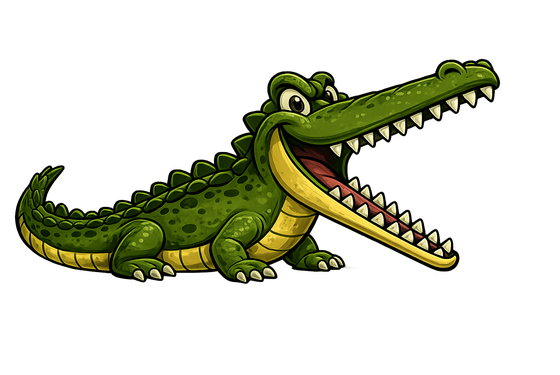
A hungry alligator always opens its mouth toward the bigger number — it wants the larger snack! The open end of < and > faces the larger value, and the point aims at the smaller one. Here the mouth gapes toward the 8, so 3 < 8.
The "or equal to" part matters 💡
The little line under ≤ and ≥ means the boundary number is included. With plain < and >, the boundary is not included. That difference is what makes a circle open or closed on a number line.
A Solution Set, Not One Answer
An equation like x = 3 has exactly one solution. But x > 3 is true for 3.1, 4, 100, a million… infinitely many numbers! That whole collection is called the solution set, and we picture it on a number line.
Open circle or closed circle?
Open circle ○ — the endpoint is not included (use with < and >).
Closed circle ● — the endpoint is included (use with ≤ and ≥).
Then shade toward every number that makes the inequality true — right for "greater," left for "less."
Solving — Just Like an Equation, With a Twist
You solve an inequality the same way you solve an equation: undo operations on both sides to get the variable alone.
⚠️ The flip rule
When you multiply or divide both sides by a negative number, flip the inequality sign. Here's why: 3 < 5 is true. Multiply both sides by −1 and you get −3 and −5 — and −3 is actually greater than −5. The order reversed, so the sign must flip.
Dividing both sides by −2 flipped the < into a >.
Graph It Yourself
Practice drawing the solution set. Tap a number to place the circle, choose open or closed, and shade in the correct direction. Then check your graph.
Practice & Earn Your Score
For each one: solve the inequality (pick the symbol and the boundary number), then graph the solution. You earn a point when both the algebra and the graph are right on the first try.